This non-promotional website is intended for UK healthcare professionals and other relevant decision makers. Adverse event reporting information can be found at the bottom of this page.
Close Mobile Navigation
Oncology: Our Work
Our work
“We are proud to collaborate with the NHS to optimise oncology pathways, giving cancer patients improved access to the right treatment; regardless of who they are or where they live. We strive to do this by supporting innovation that helps trusts achieve targets and improves patient experience.”
Arabella Brittain-Dissont, National Customer Director
Our Work
At MSD, we have developed services to support you in implementing and optimising your oncology pathways and tools to help you improve patient experience and meet targets.
Our services include:
Our MDT Meeting Optimisation Tool, to analyse your current workflow and model possible changes to manage rising demands.
Innovation projects, co-created with you to optimise patient pathways or expand capacity.
Our Pathway Development Programme, to optimise and implement pathways.
Explore previous examples of these services below, which are designed to support, but not limited to, Patient Pathways services, Multidisciplinary Teams (MDTs) and Pathology processes.
By 2030, the UK is expected to have 4 million people living with cancer1, with systemic anti-cancer treatment (SACT) demand growing 6–8% annually2. NHS trusts have struggled to meet the 31-day cancer wait time target3, and there has been no universal tool to model SACT unit demand and capacity.
To address this gap, MSD developed the Capacity Insights Tool (CIT): a comprehensive modelling solution designed to help cancer alliances and NHS trusts plan effectively.
CIT enables hospitals to analyse current capacity and explore scenarios such as increasing staff, extending hours, and introducing new services.
It supports business cases for additional resources and service innovations, including:
Centralised pre-assessments
Mobile units
Expanded homecare
Digital scheduling improvements
The impact has been significant: CIT has been adopted by 18 of 21 cancer alliances and applied across 205 SACT units. Interim results show improved treatment capacity, reduced delays, and enhanced sustainability of NHS services.
Click on a cancer alliance to view a case study of the impact of the Capacity Insights Tool in that alliance.
References:
Maddams J, et al. Br J Cancer. 2012;107(7):1195–202
Royal College of Radiologists. Policy Briefing. The SACT capacity crisis in the NHS. 2023. [Accessed 3rd March 2026].
Cancer Research (2025) Cancer waiting times: Latest updates and analysis [Accessed: 3rd March 2026].
MSD can help optimise and implement patient pathways within your NHS trust through the Pathway Development Programme (PDP). This is conducted under a collaborative working agreement which aims to support NHS organisations and healthcare professionals in delivering improved care and management for their patients.
How does the programme work?
MSD’s dedicated team will work with you to understand the current service pathway and the demands on the health service
The team will help to identify gaps in the current pathway, and highlight potential areas to improve – and the risks involved with not optimising these areas
The MSD team will facilitate conversations about the changes needed for service improvements
MSD will support in the implementation and evaluation of the service improvement, and then publish the outcomes
We have a dedicated team who develop bespoke innovative projects co-created with the NHS to optimise patient pathways or expand NHS capacity, to help meet cancer wait times.
At MSD’s Digital Think Tank, held during the National Health Service (NHS) ConfedExpo, attendees learned how digital tools can improve the cancer patient experience.
Inefficiencies in MDT meetings may affect patients’ eligibility or timely treatment of SACT treatment regimens, having a negative effect on patient outcomes and leading to a breach in cancer treatment targets.
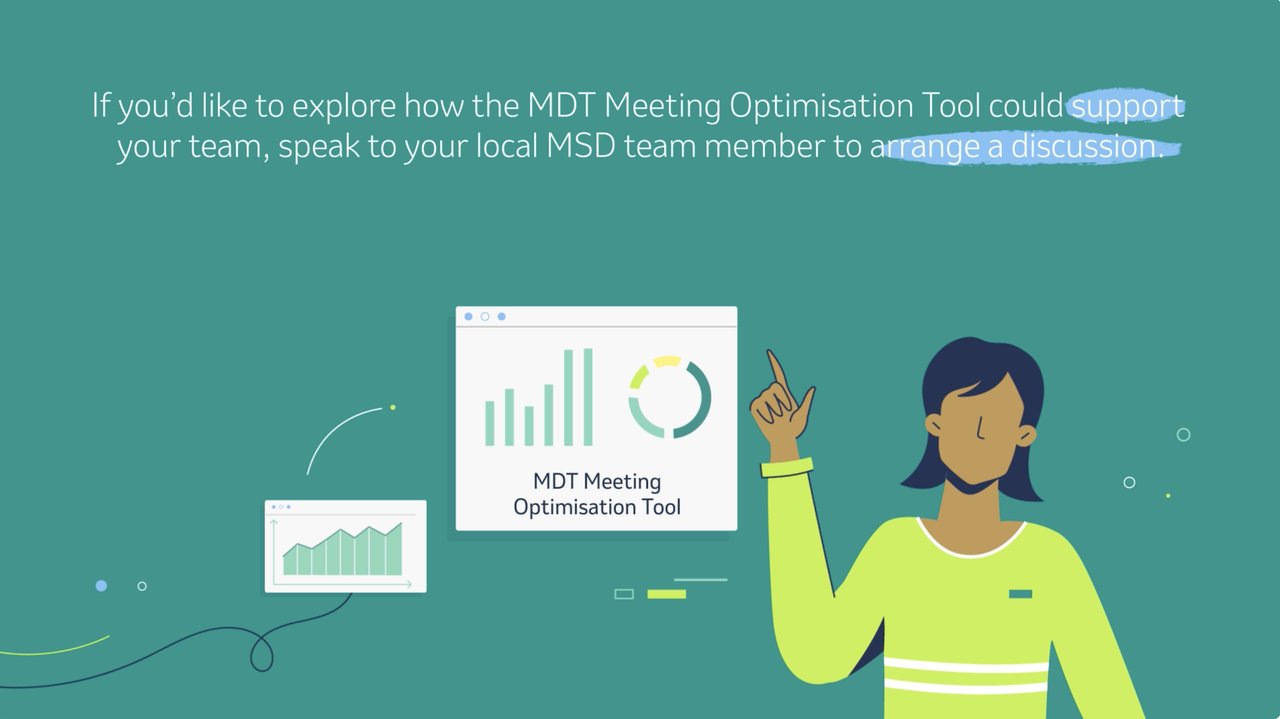
Our MDT Meeting Optimisation Tool can analyse your current workflow and model possible changes to manage rising demands.
It is a scenario-based solution that enables healthcare teams to optimise MDT meetings by capturing and analysing both capacity (meeting frequency, duration, attendance) and demand (referrals, growth), supporting data-driven decisions on resource allocation and meeting structure.
Entering your MDT details will produce a report that:
Highlights inefficiencies in the process flow that lead to deferrals or delays
Identifies the specific resources required for best practice at each stage
MSD can help optimise and implement pathways within your NHS trust through the Pathway Development Programme (PDP) . This is conducted under a collaborative working agreement which aims to support NHS organisations and healthcare professionals in delivering improved care and management for their patients.
How does the programme work?
MSD’s dedicated team will work with you to understand the current service pathway and the demands on the health service.
The team will help to identify gaps in the current pathway, and highlight potential areas to improve – and the risks involved with not optimising these areas.
The MSD team will facilitate conversations about the changes needed for service improvements.
MSD will support in the implementation and evaluation of the service improvement, and then publish the outcomes.
We have a dedicated team who develop bespoke innovative projects co-created with the NHS to optimise patient pathways or expand NHS capacity, to help meet cancer wait times.
Recruitment, workflow optimisation, and process improvements were implemented to enhance histopathology diagnosis pathways for skin and urology cancers.
Adverse events should be reported. Reporting forms and information can be found at https://yellowcard.mhra.gov.uk or search for MHRA Yellow Card in the Google Play or Apple App Store. Adverse events should also be reported to Merck Sharp & Dohme (UK) Limited (Tel: 0208 154 8000).
The link you have selected will take you to a third-party website. We do not review or control the content of any third-party site. We do not endorse and are not responsible for the accuracy, content, practices, or standards of any third-party sources.